Friday, September 23, 2011

Frog -- E.

A vital skill for linguists is a keen listening ear. We will need to distinguish between various speech sounds as soon as we get to Malaysia -- since our first task in the country will be to learn the national language, Malay. This may prove challenging.
I bring all that up because, in our home, there has been some debate as to some speech sounds James has been using. In the following video James attempts to say the word frog.


Queena believes that our son is unintentionally cussing every time he says that word. I disagree. But I do think that his r's and g's could use some work -- and I think he could avoid the problem entirely if he would just call the amphibians in the picture toads, which is what they are.

Hey, did you see the picture Queena put up a few weeks ago of all the water standing in our backyard after Irene? So did every toad in Sussex county, apparently -- and it gave them all the same idea. This week, tens of thousands of their children emerged from the late-summer swamp and surrounded our house. That's what James is looking at in the video. Here are a few more specimens:
Cute, right? One or two pinkie-nail toads are cute.

But too many is too many. Where are all the natural predators? They're not doing their job.

Thursday, September 15, 2011

"Once upon a time . . . amen." --E.

How can you tell the difference between the evening news and a bedtime story? Besides the content itself, I mean. It's true that the Libyan civil war doesn't make it into most of the stories I make up for Dorie and James before they go to sleep. But if you hear the words, "Once upon a time, in a little town called Tripoli," you know it's not the news. You also know it's not a history lesson. The story you're about to hear is a work of fiction.

How do you know? It's all about the discourse markers. Every language has them: special hints that help you keep track of your place in a story, as well as what kind of story you're listening to in the first place. Usually you don't think about these makers consciously. They're just there, and they help guide stories and conversations.

Discourse markers are an important study for people who want to translate Scripture (or any other text). For example, the Bible contains a number of accounts that it claims are historical. If you use the wrong discourse markers in telling these accounts, your translation could end up sending the subconscious message that these accounts are fairy tales.

I have not had a lot of formal training in discourse analysis, but I'm always game for a little independent research. So I asked a willing participant to tell me some stories.

Here are three brief data samples:


As for the results of my study:
  • The Observer's Paradox was a clear problem in this research. The participant kept wanting to stop and see herself in the videos I was taking.
  • The participant seemed unsure as to the nature of her discourse. The openings of "Engy and Mengy" or "Ashy and Mengy" sounded like the setup to a nursery rhyme, but the second sample ends as a prayer: "and they loveded each other and amen."
  • No more data collection at mealtimes. Those eggs got so cold it's not funny.

Thursday, September 8, 2011

If you must Stress...--QM

One of my favorite memories from this past week in Western New York (and there are many favorites!) comes from an unusual shopping trip. My mother-in-law, Esther Mast, took me to about five different local shops, most of which were located at her Amish neighbors' homes.
The last stop was a bulk food store where Mom bought 50 pounds of flour--and where I bought 1/3 pound of curry powder. A young woman took my money and stuck the packet of curry into a wrinkled bag originally from a Rite-aid pharmacy. She made sure that I noticed the words written on the side of the bag. She pointed them out to me at least two times, with a little smile and a big sense of humor that twinkled from her eyes. The words said "Stress less."

Some days our job can be stressful. Building a team of partners is a lot of fun, but we have a lot of tasks to juggle and the day never ends with everything done. I cut the wrinkled words out of the bag and put them on the fridge to remind me to keep a restful heart.

My devotional today had a similar reminder; we stress less by recognizing our weakness and his strength:
(September 8, Jesus Calling by Sarah Young)
"I will infuse My strength into you moment by moment,
giving you all that you need for this day."

"For to be sure, he was crucified in weakness, yet he lives by God's power. Likewise, we are weak in him, yet by God's power we will live with him to serve you."
2 Corinthians 13:4


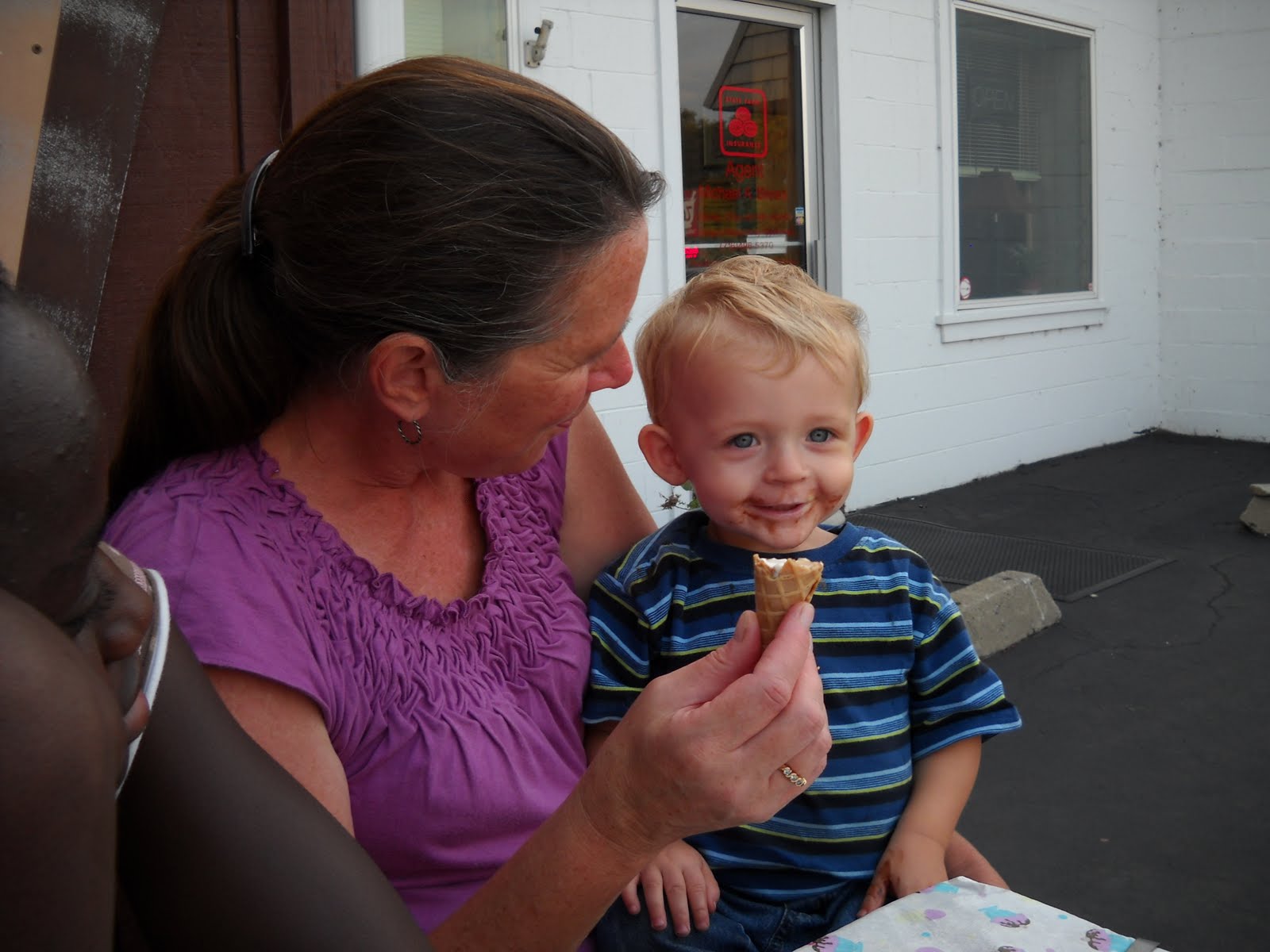
Stress-busters from this past week: Ice-cream and Games

Tuesday, August 30, 2011

Falling Leaves, Throwing Stones --QM

The formerly dry woods in the backyard

Irene left a pile of leaves around the house and in the pool. Somehow the coming of this storm seems to be the end of summer--emotionally, if not in fact. We swam in Jay and Betty's pool for the last time today, and I thought of the leaves that had been recently vacuumed out. They reminded me of the words of a man from Malaysia. He said:

"When a leaf from a tree by the river drops on the water, it takes a long time for the leaf to sink to the bottom of the river. But when you drop a stone, it goes straight to the bottom. That is how I feel about the Word of God in my own language. When I read it in the national language, though I was educated in that language, it takes a long time before the meaning sinks in. But when I read God's Word in my own language, I feel like a stone dropping to the bottom of the riverbed. It goes right in to touch my soul"


We will be traveling to Ethan's parents' home in western New York from the 1st to the 7th and would appreciate your prayers for good meetings, fun times, and safe travels!

Saturday, August 13, 2011

Dorie and the Snake--EM


[Eighteen minutes after posting this video, we've gotten enough concerned feedback that we think we should explain that this is a non-venemous Eastern Hognose Snake . . . probably.
We could tell because of its distinctive markings, and because it didn't bite us.]